This week for inquiry, we were creating DLO's (Digital Learning Objects), about the work we created. We first learnt about Matariki by reading from online sites, and remembering information from videos. Next we started to create DLO's about each subject we learnt about for the Matariki work. This DLO is about the differences and similarities bwtween now and then of the Matariki celebration. What is Matariki? Matariki is a Maori celebration for a new year. That means a new year, and a good time for crops. I liked this DLO, because you can learn about what Matariki is.
Showing posts with label LS2 2020. Show all posts
Showing posts with label LS2 2020. Show all posts
Thursday, 2 July 2020
Venn Diagram | DLO 5
Learning Intention: To find out the similarities and differences between Matariki then and now?
This week for inquiry, we were creating DLO's (Digital Learning Objects), about the work we created. We first learnt about Matariki by reading from online sites, and remembering information from videos. Next we started to create DLO's about each subject we learnt about for the Matariki work. This DLO is about the differences and similarities bwtween now and then of the Matariki celebration. What is Matariki? Matariki is a Maori celebration for a new year. That means a new year, and a good time for crops. I liked this DLO, because you can learn about what Matariki is.
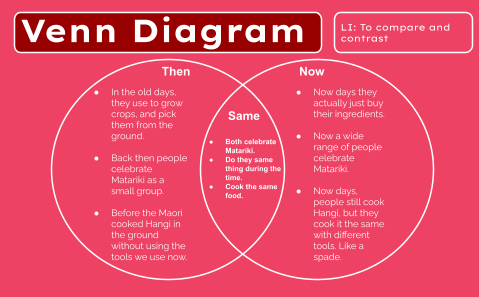
This week for inquiry, we were creating DLO's (Digital Learning Objects), about the work we created. We first learnt about Matariki by reading from online sites, and remembering information from videos. Next we started to create DLO's about each subject we learnt about for the Matariki work. This DLO is about the differences and similarities bwtween now and then of the Matariki celebration. What is Matariki? Matariki is a Maori celebration for a new year. That means a new year, and a good time for crops. I liked this DLO, because you can learn about what Matariki is.

Harvesting | DLO 4
Learning Intention: To explain what tools they used to harvest?
This week for inquiry, we were creating DLO's (Digital Learning Objects), about the work we created. We first learnt about Matariki by reading from online sites, and remembering information from videos.
Next we started to create DLO's about each subject we learnt about for the Matariki work. This DLO is about the harvesting of the Maori for Matariki. What is Matariki? Matariki is a Maori celebration for a new year. That means a new year, and a good time for crops. I liked this DLO, because you can learn about what Matariki is.
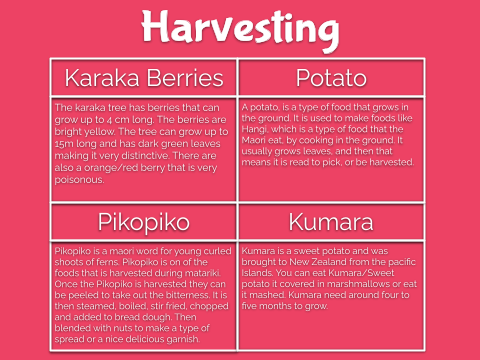
This week for inquiry, we were creating DLO's (Digital Learning Objects), about the work we created. We first learnt about Matariki by reading from online sites, and remembering information from videos.
Next we started to create DLO's about each subject we learnt about for the Matariki work. This DLO is about the harvesting of the Maori for Matariki. What is Matariki? Matariki is a Maori celebration for a new year. That means a new year, and a good time for crops. I liked this DLO, because you can learn about what Matariki is.
Importance Of Matariki | DLO 3
Learning Intention: To explain what Matariki is and why we have it?
This week for inquiry, we were creating DLO's (Digital Learning Objects), about the work we created. We first learnt about Matariki by reading from online sites, and remembering information from videos.
Next we started to create DLO's about each subject we learnt about for the Matariki work. This DLO is about what is important in Matariki. What is Matariki? Matariki is a Maori celebration for a new year. That means a new year, and a good time for crops. I liked this DLO, because you can learn about what Matariki is.

This week for inquiry, we were creating DLO's (Digital Learning Objects), about the work we created. We first learnt about Matariki by reading from online sites, and remembering information from videos.
Next we started to create DLO's about each subject we learnt about for the Matariki work. This DLO is about what is important in Matariki. What is Matariki? Matariki is a Maori celebration for a new year. That means a new year, and a good time for crops. I liked this DLO, because you can learn about what Matariki is.
Matariki Summary | DLO 2
Learning Intention: To explain in fewer words what Matariki is about?
This week for inquiry, we were creating DLO's (Digital Learning Objects), about the work we created. We first learnt about Matariki by reading from online sites, and remembering information from videos.
Next we started to create DLO's about each subject we learnt about for the Matariki work. This DLO is a summary in our own words, about what we think Matariki is and how they celebrate it. What is Matariki? Matariki is a Maori celebration for a new year. That means a new year, and a good time for crops. I liked this DLO, because you can learn about what Matariki is.
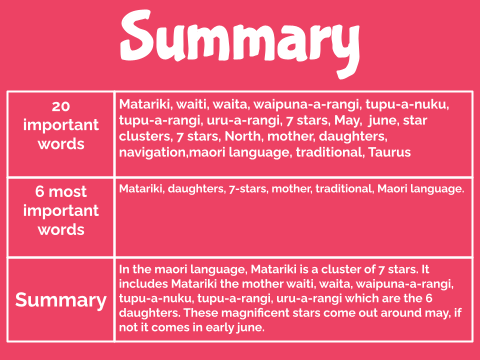
This week for inquiry, we were creating DLO's (Digital Learning Objects), about the work we created. We first learnt about Matariki by reading from online sites, and remembering information from videos.
Next we started to create DLO's about each subject we learnt about for the Matariki work. This DLO is a summary in our own words, about what we think Matariki is and how they celebrate it. What is Matariki? Matariki is a Maori celebration for a new year. That means a new year, and a good time for crops. I liked this DLO, because you can learn about what Matariki is.
What is Matariki | DLO 1
Learning Intention: To use our knowledge to explain what Matariki is?
This week for inquiry, we were creating DLO's (Digital Learning Objects), about the work we created. We first learnt about Matariki by reading from online sites, and remembering information from videos.
Next we started to create DLO's about each subject we learnt about for the Matariki work. This DLO is about what Matariki is. What is Matariki? Matariki is a Maori celebration for a new year. That means a new year, and a good time for crops. I liked this DLO, because you can learn about what Matariki is.

This week for inquiry, we were creating DLO's (Digital Learning Objects), about the work we created. We first learnt about Matariki by reading from online sites, and remembering information from videos.
Next we started to create DLO's about each subject we learnt about for the Matariki work. This DLO is about what Matariki is. What is Matariki? Matariki is a Maori celebration for a new year. That means a new year, and a good time for crops. I liked this DLO, because you can learn about what Matariki is.
Thursday, 4 June 2020
Using Exponents
L.I To understand exponents
Today, Lukah, Jayden and I, worked together as a group so solve a Hydra maths challenge. We first put our stratergy (how we worked out the question) on the DLO. Before we did this, we learnt about exponents. What is an exponent? An exponent of a number says how many times to use that number in a multiplacation question. The question was how many heads would the hydra have at the end of three and 10 days. Each day we multiplied the head by 2. Which I got to 1024, at 10 days. We put the main information on our DLO, so people who look at it, can understand the main part, of the challenge. I liked this challenge, because it was a bit hard, which I like. I also love maths, which is my favorite part of school.

Today, Lukah, Jayden and I, worked together as a group so solve a Hydra maths challenge. We first put our stratergy (how we worked out the question) on the DLO. Before we did this, we learnt about exponents. What is an exponent? An exponent of a number says how many times to use that number in a multiplacation question. The question was how many heads would the hydra have at the end of three and 10 days. Each day we multiplied the head by 2. Which I got to 1024, at 10 days. We put the main information on our DLO, so people who look at it, can understand the main part, of the challenge. I liked this challenge, because it was a bit hard, which I like. I also love maths, which is my favorite part of school.
Friday, 29 May 2020
Robotics

Today for tech, we were learning about coding, with Mrs Ferguson at Tamaki College. Our challenge, was to code the m bot, on the m block site, to move in a square. We used the programing codes, Repeat, Wait for seconds, Move, Show, and other codes. I liked coding and watching my robot sucseed. I also used lights, to show that I was indicating to turn right. I moved in a square, indicated, and did a victory dance, and move, at the end. This was fun, because I havnt been to tech in a long time, and I love coding, which is one of my most favortite techs except food tech, to go to.
Thursday, 28 May 2020
Ancestor Poem
Learning intention: To write a poem to describe your ancestors using literary devices of alliteration, onomatopoeia, metaphor, simile, hyperbole, and rhyme.

This week, we were writing poems. It was based on our ancestors. I wrote about them, and my culture. It is powerful, and it brings back memories. I used the 5 senses, powerful words, emotional words, and phrases, to make my poem stronger. My favorite part of my poem is where I talk about my ancestors travelling around the world, to find their home, and the path of success. I enjoy writing poems, because I like writing, and It is exciting. I love my poem, and I am really proud of myself.
Steps
L.I to practice our suffexes on steps
Today this morning, we were practicing suffex - ability on steps. I have completed 5 of the 10 activities set for me, and I have managed to complete them all perfectly. My favorite one was the spelling. You had to look at the words, then spell them to get them correctly. I like steps, because we can practice hard words.

Today this morning, we were practicing suffex - ability on steps. I have completed 5 of the 10 activities set for me, and I have managed to complete them all perfectly. My favorite one was the spelling. You had to look at the words, then spell them to get them correctly. I like steps, because we can practice hard words.

Wednesday, 27 May 2020
Ta'ovala Maths Challenge
L.I to find the most eficient stratergy
For this challenge we solved a question regarding ta'ovala. Ta'ovala is a traditional Tongan piece of clothing worn for special occasions. Our main information was that for 8 ta'ovala 12 meters of material was used, we need to find out how many meters of material would take to make 26 ta'ovala. First we found out how much material it would take to make one ta'ovala which we did by dividing 12 by 2, 6 by 2 and then 3 by 2 which gave us 1.5. After that we multiplied 1.5 x 10 two times which gave us 30, then we multiplied 1.5 x 6 and that gave us 9. Lastly we added 30 and 9 to give us our answer 39.
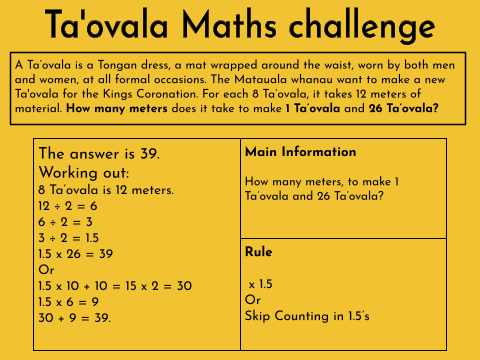
For this challenge we solved a question regarding ta'ovala. Ta'ovala is a traditional Tongan piece of clothing worn for special occasions. Our main information was that for 8 ta'ovala 12 meters of material was used, we need to find out how many meters of material would take to make 26 ta'ovala. First we found out how much material it would take to make one ta'ovala which we did by dividing 12 by 2, 6 by 2 and then 3 by 2 which gave us 1.5. After that we multiplied 1.5 x 10 two times which gave us 30, then we multiplied 1.5 x 6 and that gave us 9. Lastly we added 30 and 9 to give us our answer 39.
Tuesday, 26 May 2020
Maths Challenge
L.I to create a DLO about how you solved this maths challenge
This week for maths, we created a DLO about how we solved this maths question challenge. We first started as a big group to work out how the first question should be solved, using the most eficient stratergy. Then we chose a partner to work with. I worked with Vayan. We first worked out the answer to each question, then we out the answers on our DLO. We then put on the main information. Lastly we made a rule, which was the main focus of this session of maths.
Wednesday, 25 March 2020
Current Events 1 (Home Learning)
This is a current events 1 activity for home learning. There are 11 main types of current event titles. I have chosen 2 current events from around the world (Japan, and Venice). The 2 types of current events titles I used were odity and Relevance. The oddity was about a school graduating in minecraft. The other was sightings of dolphins, swans and fish in the clearn canal waters. These were both very interesting because I have not heard about anything the same as there subjects.
Friday, 20 March 2020
Kiwi Can Week 7
This week for kiwi Can we were learning about role models. Role models are people who inspire you and someone you can look up to. We started off with our energizer called hammer. It was related to the topic because we were trying to work together and trying to listen. Next we talked about whp role models are in our lives and how they are role models. Most people chose their mum. After we talked about who inspires you in your family. Then we played our activity called picture it. It was related to the topic because it was about working together as a team to get the picture. Lastly we played a GKQ (General Knowledge Questions) game. It was girls vs boys. The goal was to try to answer the question. When the last person gets out, their team loses. This week at kiwi can was fun.
Friday, 13 March 2020
Maths Questions DLO
This week for maths we were learning about decimals. We were mostly focusing on adding decimals in our own stratergies or learnt stratergies. I used the algorithm. It is easy because we add the numbers from top to bottom, then put the ones in the place and carry the ten to the tens. We also learnt about giving one numbers value to the other to simplify the question. This maths was very fun.
Should NZ Be A Cashless Society?
L.I to create a DLO explaining if NZ should be a cashless society and your opinion?
This week we created a DLO explaining if NZ should be a cashles society. We explained why we should, why we shouldn't and our opinion. One reason why we should is because it might be so much easier. Why we shouldn't is that people tak the time to process and make our cash or money. Our opinion is no NZ shouldn't be a cashless society, because if we use credit cards, most people won't know how to or if we don't become a cashless society, everyone can buy stuff, even kids.
Then & Now

This week for cybersmart we worked collaboratively to discover new things about a gourd. We started on by using what a gourd and what it was used for. We found out that it was used to storage fresh water to keep hydrated. We also found out that a gourd is a type of fruit which is related to the cucurbit family, which includes melon, cucumber and squash.
Thursday, 5 March 2020
Collaborated Maths DLO Question
This week in Maths, we worked collaboratively in our Maths group to solve a team challenge question. In our group we worked together to solve a maths problem about which was about trying to solve what age 3 people were, with not that many hints. After we solved the question, we created a DLO about the strategy we used and how we solved the question.
Places Named After Early Explorers To NZ
l.I to create a DLO explaning places named by early explorers (James Cook, Able Tasman and Kupe).
This is a map Vayan and I created. It talkes about the places that are named by or after, Kupe, Able Tasman, and James Cook. The most interesting place I found, was called Young Nicks Head, named after Able Tasman. One of the most hardest places to find information on was the Able Tasman National Park. This was fun because I liked to research about history.
Past and Present Captain James Cook and Kupe

Friday, 28 February 2020
Kiwi Can Week 4 Term 1
Today for kiwi can we learn about positive relationships. Our topic was fair play. We started off with our energiser called up and down. We had to try and put the cone up or down depending on which team you were on. I was in Mrs. graces’ team, and hosea and afa, were in mr, cemanus’ team. Next we were doing acting. Karlos was the actor and We had to try and make him happy again. I managed to make him happy twice and our team won. Next were street fighters. We had to be the first person to complete the amount of moves before the other player versed you. If you make the sound as well and the opposite person doesn’t, you win. We had fun and enjoyed this.
Subscribe to:
Posts (Atom)